Silver vs clad edge
A 90% silver dime, quarter, or half has a solid silver-colored edge. A clad coin shows a copper stripe in the edge sandwich. That stripe is the fastest check if the date is worn.

Beginner path · no account
You do not need the series name. Read the date and the denomination. Color is not the metal: a golden Presidential or Sacagawea dollar is not gold. Silver today is $56.30 / oz. Gold is $4,090.70 / oz. Melt comes after you know the type. Inherited a box? Start with the box path.
Decision tree
Cent (penny), nickel, dime, quarter, half dollar, or dollar. If it says ONE DIME it is a dime even if it looks gold-toned.
Use the table below. The year decides silver vs clad vs copper — not the portrait alone. A Washington quarter can be silver (1964 and earlier) or clad (1965-on).
Color is not gold. Jump to gold-colored vs real gold if it is a golden dollar, a plated Ike, or a “$50 Buffalo.” Real gold coins state the weight and fineness, or they are small pre-1933 $2.50–$20 pieces.
That page shows today’s melt, whether the type usually sells above melt, and what to check before you sell.
| Denomination | Silver years | Not silver | Open |
|---|---|---|---|
| Cent | Never silver. 95% copper through mid-1982. Large cents, Indian Head, Flying Eagle, and two-cent pieces are copper (or copper-nickel for some Indian/Flying Eagle years). | Zinc cents 1982-on (copper-plated). 1982 is both — weigh it. | 1982 penny · Wheat · Zinc |
| Nickel | 1942–1945 war nickels only (large mintmark on reverse). 35% silver. | All other Jefferson, Buffalo, Liberty, Shield nickels. | 1943 nickel · War nickel |
| Dime | 1964 and earlier, 90% silver (Barber, Mercury, Roosevelt 90%). | Roosevelt 1965-on clad. | 1964 dime · 1965 dime |
| Quarter | 1964 and earlier, 90% silver. 1976 silver proofs exist for collectors. | Washington 1965-on clad (except silver proofs). | 1964 quarter · 1965 quarter |
| Half dollar | 1964 Kennedy and all earlier halves: 90%. 1965–1970 Kennedy: 40% silver. | Kennedy 1971-on clad (except silver proofs). | 1964 90% · 1965–70 40% · 1971 clad |
| Dollar | Morgan, Peace, Trade, and earlier dollars: 90%. Some Ike dollars 40% silver. Silver Eagles: 1 oz. | Ike clad, SBA, Sacagawea, Presidential, and Innovation dollars. Golden color ≠ gold — see below. | Morgan · Peace · Silver Eagle |
A 90% silver dime, quarter, or half has a solid silver-colored edge. A clad coin shows a copper stripe in the edge sandwich. That stripe is the fastest check if the date is worn.
1942–1945 silver nickels have a large P, D, or S above Monticello on the reverse. A 1942 nickel without that large mark is not the silver wartime alloy.
1964 = 90% silver. 1965–1970 = 40% silver (still no copper stripe like later clad). 1971-on business strikes = clad. Proof silver later is a collector strike, not junk silver.
Gold-colored is not gold
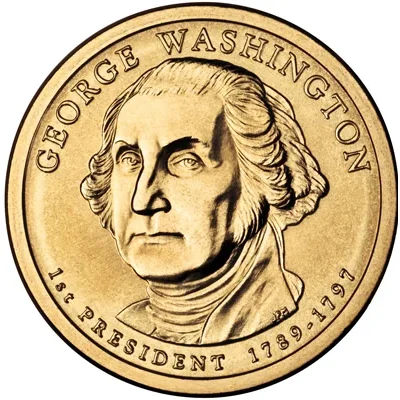
A golden $1 in change is almost never gold. Gold today is $4,090.70 per troy oz — a real 1 oz gold coin weighs about four Sacagawea dollars, not one light dollar.
| What you have | What it is | Gold melt? | Open |
|---|---|---|---|
| Presidential dollar (2007–2016) | Manganese brass over a copper core. Lettered edge. Face $1. About 8.1 g. | No | Presidential dollar |
| Sacagawea / Native American / Innovation $1 | Same golden alloy as the Presidential dollar. Sacagawea 2000–date; Native American reverse 2009-on; Innovation 2018-on. | No | Sacagawea dollar |
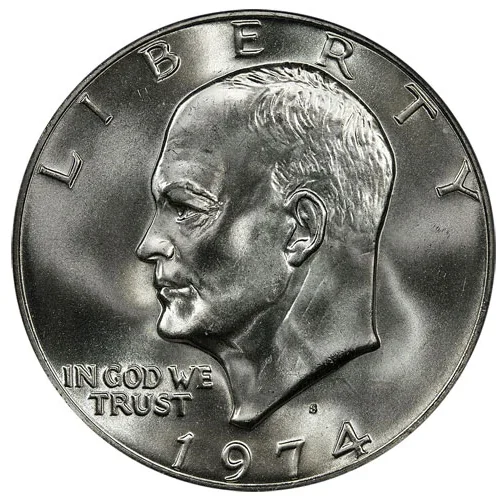
| Gold-plated Ike, Morgan, or “24K layered” novelty | A real clad or silver coin (or a copy) with a thin gold wash. Ads say “layered,” not “1 oz fine gold.” | No | Ike clad · Ike 40% silver |
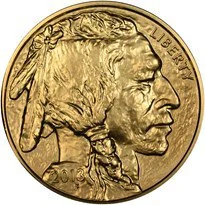
| Novelty “$50 Gold Buffalo” | Often copper or brass, sometimes marked copy. Wrong weight (not ~31.1 g) and no “1 OZ. .9999 FINE GOLD.” | No | Real Gold Buffalo $50 |
| American Gold Buffalo $50 (2006–date) | 1 oz .9999 gold. About 31.1 g. Reads 1 OZ. .9999 FINE GOLD. Face $50. | Yes · 1 oz | Gold Buffalo 1 oz |
| American Gold Eagle $50 (1986–date) | 1 oz gold (22k alloy, 1.000 oz pure, ~33.9 g). Face $50. Also 1/10, 1/4, 1/2 oz. | Yes | Gold Eagle 1 oz |
| US $1 gold (1849–1889) | Tiny real gold dollar (~1.7 g, 90% gold). Not the golden $1 in change. | Yes | Type 1 gold $1 |
| Pre-1933 US $2.50, $5, $10, $20 | 90% gold. Small and heavy for the size. Liberty, Indian, Saint-Gaudens. | Yes | Saint-Gaudens $20 · All gold |
Canada reused $20 and $100 on coins that do not hold the same gold. Weigh it. On the home page, set the catalog filters to Gold and Canada, or open the matching type.
| What it looks like | What it actually is | Gold melt? | Open |
|---|---|---|---|
| 1967 $20 Confederation | 18.27 g, .900 gold, 0.5288 oz. Only the year 1967. No P under the Queen. | Yes · 0.5288 oz | 1967 $20 gold |
| 2017 $20 with 1967 and 2017 | Gold-plated silver, 9.25 g. P under the Queen. Copies the 1967 gold $20. Not gold melt. | No · silver only | 2017 plated $20 |
| 1976 Olympic $100 (larger, paler) | 14k, 13.34 g, 27 mm, 0.250 oz. Uncirculated. | Yes · 0.250 oz | 1976 $100 14k |
| 1976 Olympic $100 (smaller, proof) | 22k, 16.97 g, 25 mm, 0.500 oz. Twice the gold of the 14k. | Yes · 0.500 oz | 1976 $100 22k |
| $100 proofs 1977–1986 | 22k, 16.97 g, 0.500 oz. Design changes each year. | Yes · 0.500 oz | $100 22k |
| $100 proofs 1987–2003 | 14k, 13.34 g, 0.250 oz. Same face, half the gold of 1977–1986. | Yes · 0.250 oz | $100 14k |
| $100 proofs 2004-on | Still 14k, but 12.00 g / 0.225 oz. Weigh it: 12 g vs 13.3 g. | Yes · 0.225 oz | $100 14k 12 g |
| Gold Maple Leaf | 1 oz, 1/2, 1/4, 1/10, 1/20, 1/15, 1/25 oz, and 1 g. Marked 9999 and the size. | Yes · size on coin | 1 oz Maple · All gold |
| 1912–1914 $5 and $10 | Canada’s first gold coins. $5 = 0.2419 oz, $10 = 0.4838 oz, .900 fine. | Yes | $5 · $10 |
Presidential, Sacagawea, Native American, and Innovation dollars are gold-colored, not gold. They weigh about 8 grams. A real 1 oz gold coin weighs about 31–34 grams — four times as much — and is larger.
Aftermarket plating on an Eisenhower dollar (large 1971–1978 $1) does not make it a gold coin. The wash is too thin to figure as gold melt. The coin underneath is clad or, for some collector Ikes, 40% silver.
TV and flea-market “gold Buffalos” are usually copper or brass copies. A genuine Gold Buffalo says 1 OZ. .9999 FINE GOLD, faces $50, and weighs about 31.1 grams (one troy ounce). If it is light, oversized, or only says “layered,” it is not bullion.
If it is a common worn 1964 quarter in a bag, you are usually in melt territory. If it is a Morgan dollar, an 1883 Hawaii coin, or a proof Silver Eagle, stop and check the date — melt is the floor, not the typical price. Each type page has a plain-English label: usually near melt, often above melt, check dates, or bullion premium. This page is date, denomination, color, and weight.
← Calculator · What US coins are silver? · Gold types · 90% bags
A local coin shop can look at what you have. Melt may not be the whole story — dates and condition matter.